Head-to-Head: Nikon Z 24 70Mm F 2 8 S Ii vs Dwarflabs Dwarf Iii (Detailed Comparison)
The world of optics is currently experiencing a fascinating divergence. On one side, we have the pinnacle of traditional optical engineering: the Nikon Z 24-70mm f/2.8 S II, a professional-grade zoom lens designed to squeeze every ounce of performance out of high-resolution full-frame sensors. On the other side, we see the rise of the "smart" telescope and computational camera, exemplified by the Dwarflabs Dwarf III. While these two devices might seem like they belong in different universes, they represent the primary choice modern imaging enthusiasts face: the pursuit of manual perfection versus the convenience of automated, AI-driven capture.
This comparison is essential because the lines between "photography" and "imaging" are blurring. A travel photographer might find themselves choosing between a heavy, high-end lens for their mirrorless body and a compact, all-in-one smart device that can track stars and birds with the tap of a smartphone screen. In this detailed analysis, we will explore the technical specifications, real-world applications, and the distinct philosophies behind the Nikon Z S-line flagship and the Dwarflabs technological underdog.
Understanding the Nikon Z 24-70mm f/2.8 S II
The Nikon Z 24-70mm f/2.8 S II (often referred to simply as the 24-70mm S-line Pro) is the cornerstone of the Nikon Z mount system. It is built for a singular purpose: to provide uncompromising image quality across the most common focal range used by professionals. From weddings and journalism to landscapes and portraiture, this lens is meant to be the "workhorse" that never leaves the camera body.
The "S" designation in Nikon’s nomenclature signifies the highest level of optical quality. In this second iteration, Nikon has refined the optical formula to further reduce chromatic aberration and ghosting. The lens employs a complex arrangement of extra-low dispersion (ED) elements and aspherical glass, treated with Nano Crystal Coat and ARNEO coatings. This creates a level of contrast and color reproduction that is difficult to replicate with smaller, consumer-grade optics. For the buyer, this translates to images that require less post-processing and retain incredible sharpness even at the edges of the frame when shot wide open at f/2.8.
Physical handling is another area where the Nikon excels. It features a dedicated OLED information panel on the lens barrel, allowing photographers to check their focal distance, aperture, and depth of field even in low-light conditions. Furthermore, the inclusion of a customizable control ring and an "L-Fn" (Lens Function) button allows for tactile adjustments without looking away from the viewfinder. This is a tool designed for the "decisive moment," where speed and reliability are paramount.
Pros and Cons of the Nikon Z 24-70mm f/2.8 S II
- Pro: Exceptional Optical Performance – The lens delivers corner-to-corner sharpness and beautiful bokeh that makes subjects truly stand out from the background.
- Pro: Weather Sealing – Built like a tank, this lens is designed to withstand dust, moisture, and extreme temperatures, making it suitable for professional field use.
- Pro: Fast and Silent Autofocus – Utilizing dual stepping motors (STM), the autofocus is nearly instantaneous and completely silent, which is vital for both wedding photography and video production.
- Pro: Physical Controls – The OLED display and customizable rings provide a level of manual control that experienced photographers rely on.
- Con: High Cost – This is an investment piece, often costing more than mid-range camera bodies themselves.
- Con: Weight and Size – When paired with a professional Z-series body, the setup is heavy and can cause fatigue during long shooting sessions.
- Con: Fixed Focal Range – While 24-70mm is versatile, it offers no reach for wildlife or astronomical subjects.
Unpacking the Dwarflabs Dwarf III
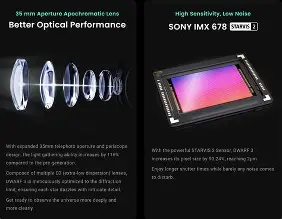
The Dwarflabs Dwarf III represents the "New Wave" of imaging. It is a portable, smart, all-in-one dual-camera system that integrates a wide-angle lens and a telephoto lens into a single, compact body powered by AI and an internal computer. While the Nikon is a component of a system, the Dwarf III is the entire system. It does not require a camera body; instead, it uses your smartphone or tablet as its brain and viewfinder.
The Dwarf III is specifically marketed toward those who want to bridge the gap between traditional photography, birdwatching, and astrophotography. It features a periscope-style telephoto lens that offers incredible magnification relative to its size. But its real secret sauce is the computational backend. The device can automatically identify objects—be it a rare bird in a tree or the Andromeda Galaxy in the sky—and track them with motorized precision. It performs "stacking" in real-time, a process where multiple exposures are combined to reduce noise and bring out detail in faint astronomical objects.
For the modern user, the appeal lies in the lack of a learning curve. While the Nikon requires knowledge of exposure triangles, focus modes, and RAW processing, the Dwarf III handles the "boring" parts of the process. It levels the playing field for hobbyists who want professional-looking astro shots without spending years learning the intricacies of equatorial mounts and polar alignment.
Discover deals on Cameras & Photography — updated daily.
View Offers →Pros and Cons of the Dwarflabs Dwarf III
- Pro: Portability – The device is small enough to fit in a jacket pocket or a small backpack, unlike a full mirrorless kit.
- Pro: Automated Tracking – The built-in AI can track fast-moving birds or compensate for the Earth's rotation during long-exposure astrophotography.
- Pro: Dual-Camera System – Having both a wide-angle and a powerful telephoto lens in one unit allows for unique "picture-in-picture" views and versatility.
- Pro: Price to Value Ratio – For the cost of a basic lens, you get a full imaging kit including the tripod, motors, and software.
- Con: Small Sensor Limitations – Because it uses smaller sensors than a full-frame Nikon, it cannot match the raw dynamic range or low-light performance of a pro camera.
- Con: Dependency on Software – The device is almost entirely reliant on its app; if the software is buggy or the phone dies, the device becomes difficult to use.
- Con: Fixed Hardware – Unlike the Nikon system, you cannot upgrade the sensor or the optics; when the technology becomes dated, you must replace the whole unit.
Direct Specification Comparison
Comparing these two is like comparing a high-performance sports car to a futuristic electric scooter. One is built for raw power and control; the other is built for efficiency and ease of use. The following table highlights the core differences in their "hardware" approach.
| Feature | Nikon Z 24-70mm f/2.8 S II | Dwarflabs Dwarf III |
|---|---|---|
| Device Type | Interchangeable Zoom Lens | Smart All-in-One Computer Camera |
| Aperture | Constant f/2.8 | Variable (Digital/Fixed depending on lens) |
| Focal Length | 24-70mm (Standard Zoom) | Dual (Wide + Ultra-Telephoto Periscope) |
| Weight | Approx. 805g (Lens Only) | Approx. 1.2kg (Total Unit) |
| Primary Use Case | Events, Portraits, Landscapes | Astrophotography, Nature, Birding |
| User Control | Full Manual / Physical Rings | App-Based / AI-Automated |
| Sensor Size | N/A (Uses Full Frame) | Integrated Small-Format Sensors |
Performance Analysis: Real-World Use Cases
To truly understand which device fits a buyer's lifestyle, we must look at how they perform in the field. The Nikon and the Dwarf are designed for different types of "work," even if they both result in a digital image.
Professional Event and Portrait Work
In this arena, there is no contest. The Nikon Z 24-70mm f/2.8 S II is the undisputed champion. At a wedding, the lighting is often unpredictable and the subjects are constantly moving. The f/2.8 aperture allows for a shallow depth of field that separates the bride and groom from the background clutter, creating an "expensive" look that client’s demand. The speed of the autofocus ensures that you don't miss the first kiss or the ring exchange. The Dwarf III, with its reliance on an app interface and smaller sensors, would struggle in these high-pressure, low-light environments where every millisecond counts.
Astrophotography and the Night Sky
This is where the comparison gets interesting. To replicate what the Dwarf III does with a Nikon system, you would need much more than just the 24-70mm lens. You would need a sturdy tripod, a star tracker (equatorial mount), a remote shutter release, and hours of software processing time on a PC to "stack" the images. The Dwarf III does this automatically. While a full-frame Nikon shot of the Orion Nebula taken by an expert will always look better than a Dwarf III shot, the Dwarf III allows a beginner to get a recognizable, beautiful image of that nebula in five minutes without any prior knowledge. For the casual observer of the stars, the Dwarf III is the superior tool because it removes the barriers to entry.
Wildlife and Birdwatching
The Nikon 24-70mm is essentially useless for birding; it simply doesn't have the reach. To get a close-up of a hawk with a Nikon Z camera, you would need to buy a separate 400mm or 600mm lens, which adds thousands of dollars to the kit. The Dwarf III has a dedicated telephoto lens that can zoom in significantly, combined with AI that can "lock on" to a bird and follow its movement. For a hiker who wants to document the wildlife they see without carrying 10 pounds of glass, the Dwarf III is a revolution in convenience.
The Buying Guide: Which One Should You Choose?
Choosing between these two depends entirely on your goals as a creator and your willingness to invest time in the "craft" versus the "result."
Choose the Nikon Z 24-70mm f/2.8 S II if...
You are a professional or an aspiring pro who values image quality above all else. If you plan on printing your photos in large formats, selling your work, or shooting for clients, the optical purity of the S-line lens is non-negotiable. You likely already own a Nikon Z6, Z7, Z8, or Z9, and you want a lens that can keep up with those high-resolution sensors. You enjoy the tactile experience of photography—the click of the rings, the weight of the metal, and the control of manual settings. This lens is a life-long investment that will hold its value for years to come.
Discover deals on Cameras & Photography — updated daily.
Shop Amazon →Choose the Dwarflabs Dwarf III if...
You are a tech-driven hobbyist, a traveler, or a science enthusiast. If your primary interest is seeing things that are far away—like craters on the moon or a nest in a distant tree—and you want to capture those images without becoming a technical expert in optics, the Dwarf III is for you. It is perfect for those who want to "set it and forget it." You can set the Dwarf on a table during a picnic, tell it to track the sun or the stars, and go back to your conversation while it handles the imaging. It is the ultimate tool for "documenting" your world rather than creating "fine art" in the traditional sense.
Considerations on Longevity and Ecosystem
Buyers should also consider the ecosystem. The Nikon lens is part of a massive lens mount system. You can buy it today and know that in ten years, it will still work on the latest Nikon Z bodies. The Dwarf III is a self-contained electronic device. Like a smartphone, its battery will eventually degrade, and its processor will eventually feel slow compared to newer models. However, the initial entry price is so much lower that many find the "shorter" lifespan acceptable for the amount of joy and utility it provides in the moment.
Conclusion
The Nikon Z 24-70mm f/2.8 S II and the Dwarflabs Dwarf III represent two different peaks of modern technology. The Nikon is the peak of glass—the refinement of centuries of optical physics to create a lens that sees better than the human eye. The Dwarf III is the peak of integration—the combination of sensors, robotics, and artificial intelligence into a device that thinks for the user.
For the professional photographer, the Nikon remains an essential tool that cannot be replaced by a smart device. Its ability to capture raw data, its weather-resistant build, and its beautiful rendering of light make it an extension of the artist's hand. It is meant for the creator who wants to be in total control of every pixel.
For the modern explorer, the Dwarf III is a gateway to worlds that were previously too expensive or too complicated to access. It democratizes astrophotography and long-range nature observation, making it possible for anyone with a smartphone to become a chronicler of the natural world. It is the perfect companion for the "casual pro" who values the story and the subject over the technical purity of the file.

Ultimately, the decision isn't just about focal lengths or f-stops; it's about how you want to interact with the world. If you want to master the art of light, choose the Nikon. If you want to explore the wonders of the universe with ease, choose the Dwarf.